
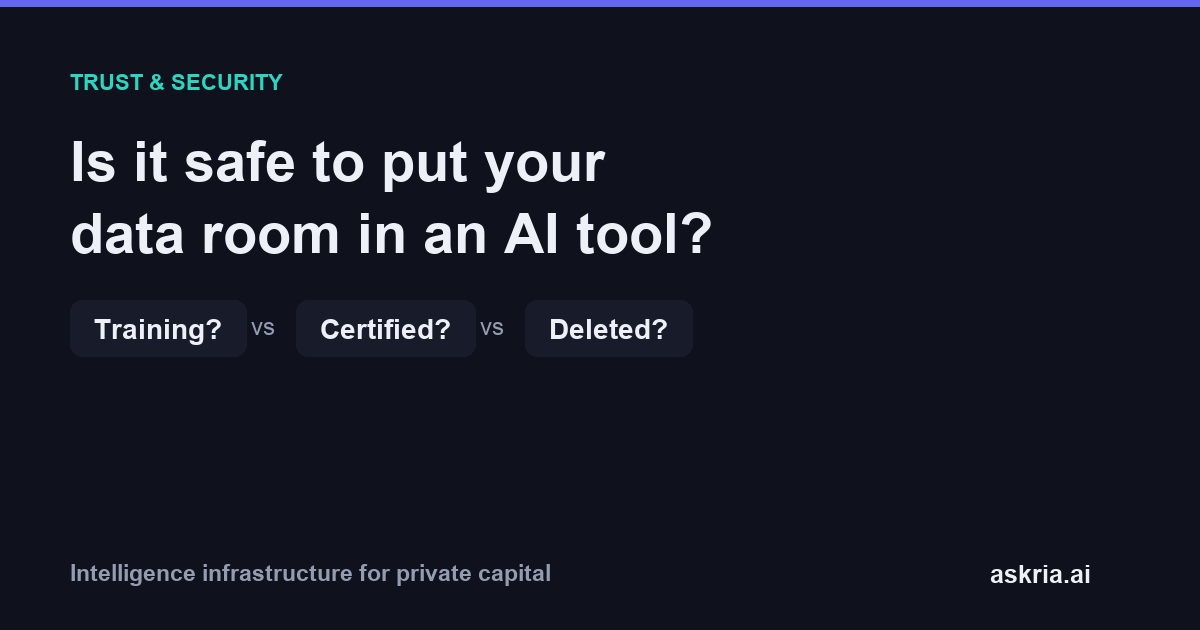
One of the first questions we get during onboarding is whether it's safe to upload a data room to an AI tool. We've answered this question hundreds of times during onboarding, and the answer is always the same. It's exactly the question founders and investors should be asking. The answer has very little to do with AI itself, and everything to do with how the platform handles your data.
Not Every AI Tool Handles Confidential Documents the Same Way
The phrase "AI tool" has become a catch-all for products that have very little in common. Uploading confidential financial documents into a free chatbot is fundamentally different from uploading a virtual data room into an enterprise AI platform built for M&A due diligence.
The risk isn't "AI" itself. It's how a specific platform stores, processes, and protects your data.
Instead of asking whether AI is safe, ask three much more specific questions. Any vendor that handles confidential information should be able to answer them clearly.
Question 1: Does the AI Train on Your Data?
Some consumer AI tools may use uploaded content to improve their models unless you opt out. That's not a risk you want to take with a virtual data room containing financials, customer contracts, or board materials.
Enterprise platforms built for due diligence should state clearly that they do not train on customer data. Before you upload anything sensitive, make sure that commitment is in writing and not implied.
Question 2: Can the Vendor Prove Its Security?
Trust is not a vibe. It is an audit. The signals that mean something:
- SOC 2 Type II: SOC 2 Type II is one of the strongest indicators that an enterprise AI platform has formal controls around data security, access management and operational processes.
- ISO 27001: An international standard for information security management.
- GDPR and CCPA compliance: Required if you, or the people in your documents, sit in the EU or California.
askRIA is compliant with SOC 2 Type II, ISO 27001, GDPR, and CCPA. These aren't badges for a website footer, they're independently verified standards that demonstrate how we handle security and customer data. Any serious vendor should be willing to share their reports under NDA.
Question 3: What Happens to Your Documents After Upload?
This is where the marketing term zero data retention gets thrown around like confetti. "ZDR" sounds absolute. In practice, vendors define it however suits them, so make them be specific.
Ask this:
- What exactly is deleted, and what is retained?
- For how long? Is there a hard deletion timeline, or just a vague "we may delete"?
- Do any subprocessors, meaning the other services the tool relies on, keep copies?
- Can I trigger deletion myself, on demand, without emailing support and waiting a week?
A good vendor should be able to answer each of these clearly. If the answers are vague, you've learned something important.
The 60-Second Security Checklist
Before uploading your virtual data room, make sure the platform can demonstrate:
- A written commitment that your data is not used to train AI models
- SOC 2 Type II and ISO 27001 certification
- GDPR and CCPA compliance, where applicable
- A clear data retention and deletion policy
- Transparency around sub processors and what they can access
- Role-based access controls for customer data
If a vendor can confidently answer all six, you're in a much stronger position to trust them with confidential information. If they can't, keep looking.
The Bottom Line
"Is AI safe?" isn't the right question.
A better one is: "How does this platform protect my data?"
Ask whether it trains on customer data, whether it can prove its security, and what happens to your files once you're done. Those answers tell you far more than any marketing page ever will.
And ask those questions of every vendor including us. The right vendors won't hesitate to answer.
Keep reading
*We built askRIA assuming every founder and investor would ask these questions. That's why we don't train on customer data, maintain SOC 2 Type II and ISO 27001 certifications, comply with GDPR and CCPA, and explain exactly how your data is handled. Try it on your first deal free, or build a founder data room in 24 hours, no credit card.*
FAQ
- Can I upload a virtual data room to ChatGPT or Claude?
Consumer AI tools and enterprise AI platforms have different security policies. Before uploading confidential documents, confirm whether the platform trains on user data, how long it retains files, and whether it meets recognised enterprise security standards.
2. What security certifications should an AI due diligence platform have?
Look for SOC 2 Type II, ISO 27001, GDPR compliance, CCPA compliance, strong encryption, role-based access controls, and transparent data-retention policies.
3. Is enterprise AI safer than consumer AI?
Enterprise AI platforms are generally designed for confidential business information and usually include stronger security controls, contractual commitments, and compliance certifications than consumer AI products.
4. Can AI read confidential financial documents safely?
Yes, provided the platform is designed for enterprise document processing, does not train models on customer data, and provides appropriate security certifications and deletion controls.